Eagle Point Credit Co (ECC)·Q4 2025 Earnings Summary
Eagle Point Credit Slashes Dividend 57% as CLO Equity Faces 'Difficult Market Conditions'
February 17, 2026 · by Fintool AI Agent
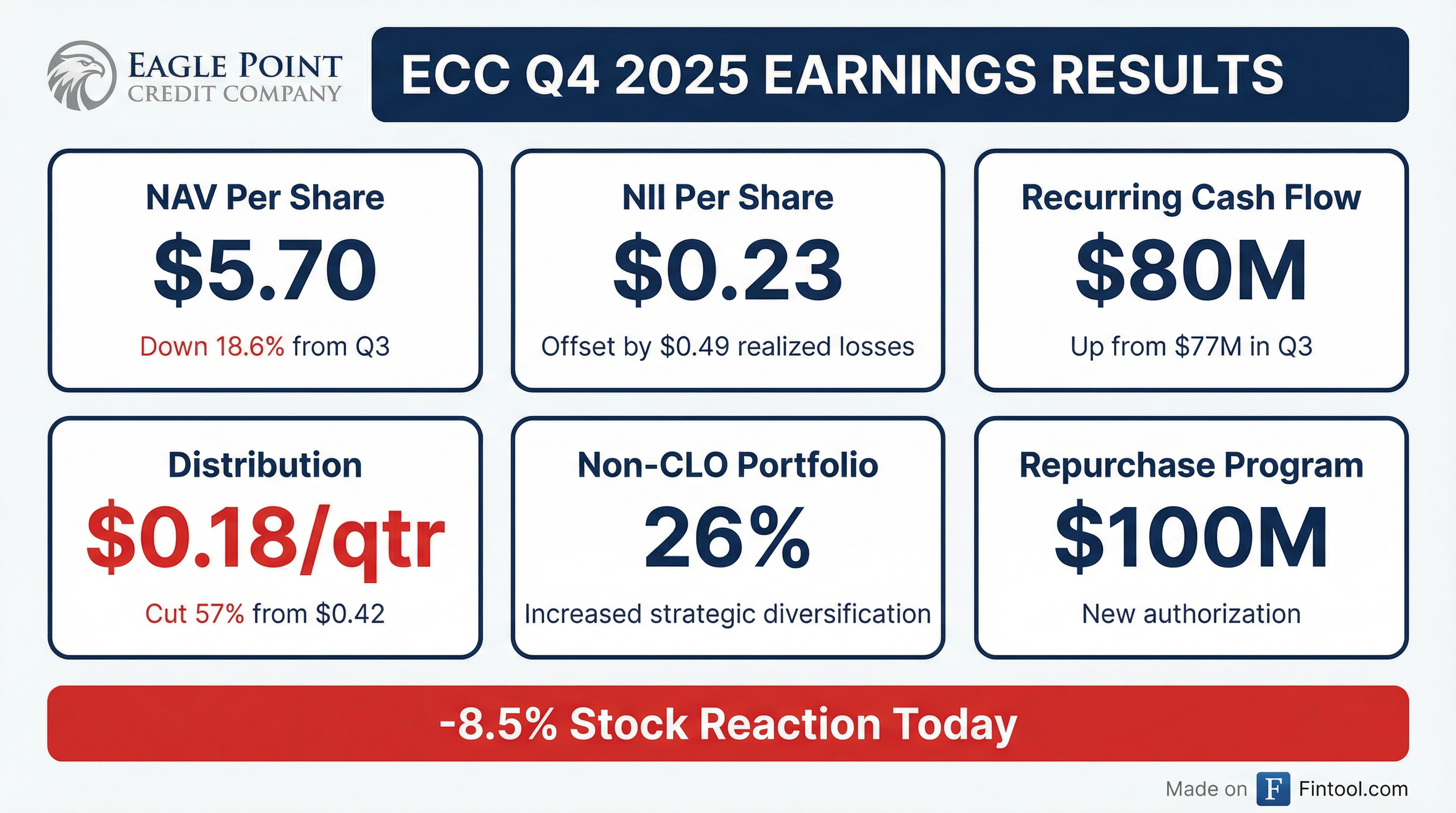
Eagle Point Credit Company (NYSE: ECC) reported Q4 2025 results this morning that beat on Net Investment Income but were overshadowed by a 57% dividend cut, a sharp NAV decline, and management commentary suggesting 2026 could mirror the challenging conditions of 2025. The stock fell 8.5% in response, hitting a fresh 52-week low.
CEO Thomas Majewski was characteristically candid: "2025, CLO Equity faced difficult market conditions, and the company was not immune to these market-wide conditions."
Did Eagle Point Credit Beat Earnings?
Yes, but context matters. The headline numbers beat expectations, but the real story is in the GAAP loss and NAV destruction:
*Values retrieved from S&P Global
The NII beat was more than offset by $64 million in realized losses (including $52M from rotating out of underperforming collateral managers) and $69 million in unrealized losses.
For the full year, ECC generated a GAAP return on equity of -14.6%, which management noted was "modestly better than Nomura's market-wide assessment" of -15% median CLO equity returns.
 Ask Fintool AI Agent
Why Did ECC Cut the Dividend 57%?
This is the headline that moved the stock. ECC reduced its quarterly distribution from $0.42 to $0.18 per share (from $0.14/month to $0.06/month), effective Q2 2026. The board cited several factors:
- Aligning with near-term earnings potential — NII of $0.23 provides only modest cushion above the new $0.18 distribution
- Retaining capital for higher-return investments — Management sees better risk-adjusted returns in non-CLO credit assets
- Supporting NAV stability — "A nontrivial part of NAV decline from last year was simply from paying out cash to shareholders"
The new yield at current prices (~17% annualized) remains attractive, but represents a significant reset of shareholder expectations.
View Q4 2025 earnings transcript
How Did the Stock React?
ECC shares fell 8.5% on the earnings release, dropping from $4.47 to a low of $3.92 before recovering slightly to $4.09. The stock is now:
- Down 52% from its 52-week high of $8.86
- Trading at a 28% discount to NAV ($4.09 vs $5.70 NAV)
- At fresh 52-week lows
Management announced a $100 million share repurchase program to opportunistically buy stock when trading at "a material discount to NAV." When asked if current prices qualify, CEO Majewski said it's "an art, not a science" and the company will balance share price against investment opportunities.
What Changed From Last Quarter?
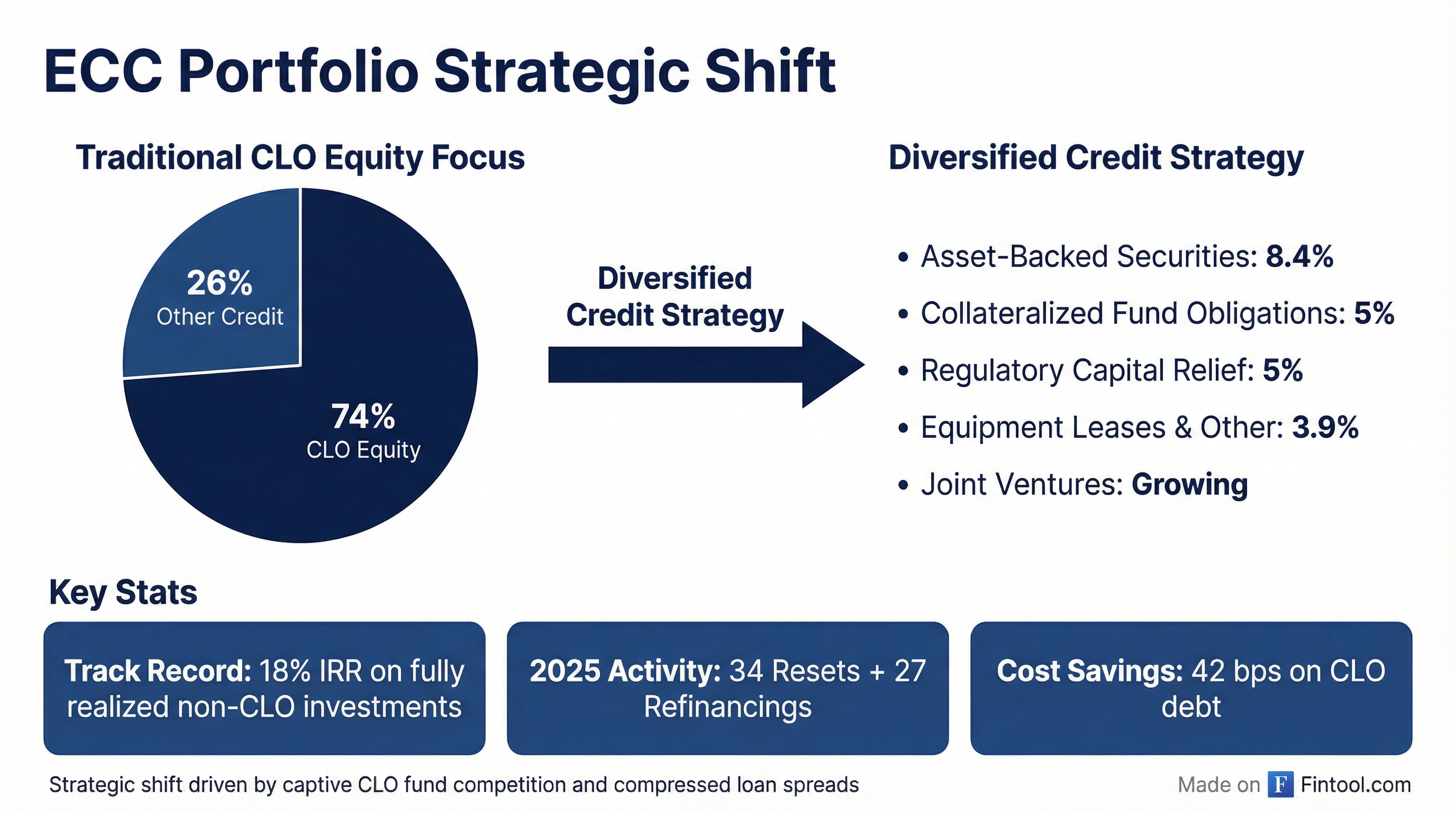
The strategic pivot away from CLO equity accelerated. During Q4, of the $184 million deployed, $147 million (80%) went to non-CLO credit assets.
What Did Management Say About 2026?
Outlook: More of the same. Majewski was asked directly whether 2026 would mirror 2025, and his response was telling:
"If I were to wake up and guess our loan spreads at 300 or 340 on July one, my expectation is they'd be at 300 versus 340. I see a trend towards continuing spread compression."
On CLO liabilities: "I do see CLO tightening, but again, not at the same pace of loans."
On credit losses: "My tea leaf is it's about the same as last year... We're not predicting a significant uptick in credit expense, and we're also not seeing a significant improvement in it either."
Translation: The CLO equity arbitrage (loan spreads minus liability costs) will likely remain compressed, providing headwinds for the asset class.
Ask Fintool AI AgentWhat's Driving the Strategic Shift Away From CLO Equity?
Management was unusually forthcoming about why they're pivoting:
Captive CLO Funds Are Distorting the Market
"A super majority, probably more than 75% of all CLOs created in the second half of 2025, were taken by captive funds, and that's distorting to the market."
These captive funds (often backed by large asset managers) are "return-insensitive buyers" that create excess demand for loans, compressing spreads.
Non-CLO Investments Have Outperformed
ECC has been building its alternative credit portfolio since 2022:
- $97 million of investments have gone full cycle
- 18% gross IRR on fully realized non-CLO investments
- Portfolio includes: asset-backed securities (8.4%), collateralized fund obligations (5%), regulatory capital relief (5%), equipment leases, and joint ventures
Management expects the non-CLO allocation to "increase further based on where we see the most attractive investment opportunities."
What About the Balance Sheet?
ECC's leverage ratio stood at 48% at quarter-end, above the target range of 27.5%-37.5%. After redeeming the 8% Series F Preferred on January 30, leverage improved to 46%. Management plans to bring it back to target over time.
Key financing moves:
- Redeemed $155M of 8% Series F Term Preferred (highest cost financing)
- Issued $155M of 7% Series AA/BB convertible perpetual preferred in 2025
- No maturities before April 2028
- All financing is fixed rate
"We're aware of no other publicly traded entity that invests primarily in CLO equity with perpetual financing and consider this to be a material competitive advantage."
Q&A Highlights
On Share Repurchases:
"Looking at our leverage ratios is something we look at, and looking at relative investment opportunities. Here we have situations where we might be able to put investments in that hopefully perform as well as or even maybe better than some of our historic non-CLO investments, in which case maybe we'd err more that way."
On NAV Stability Going Forward:
"One immediate thing is paying out cash well in excess of net investment income. We've changed that... the new distribution rate at $0.06 a month, our net investment income was $0.23 last quarter. So we baked in some cushion there."
On Changing the Fund's Investment Objective:
"We're not buying gold mines or crypto, things like that. We're sticking within core credit competencies... Our board has been supportive of gradually increasing the allocation away from CLOs as the opportunities present themselves."
Forward Catalysts
Ask Fintool AI AgentKey Risks to Monitor
- Continued CLO equity underperformance — Captive fund competition isn't going away
- Further NAV erosion — January estimate already shows another 3-5% decline
- Execution risk on strategic pivot — Non-CLO investments are less liquid and harder to value
- Leverage above target — 46% vs 27.5-37.5% target range
Bottom Line
Eagle Point Credit's Q4 was a tale of two stories. The operating metrics (NII, recurring cash flow) held up reasonably well, but the GAAP results and NAV performance reflected the brutal conditions facing CLO equity investors. The 57% dividend cut is a necessary reset, but it represents a significant shift in the shareholder value proposition.
Management is being transparent about the challenges and pivoting the portfolio accordingly. The question for investors is whether the ~28% discount to NAV and ~17% yield compensate for the risk that 2026 may indeed "mirror 2025."
This analysis is based on Eagle Point Credit's Q4 2025 earnings call held February 17, 2026. Full financials will be published in the annual report by month-end.